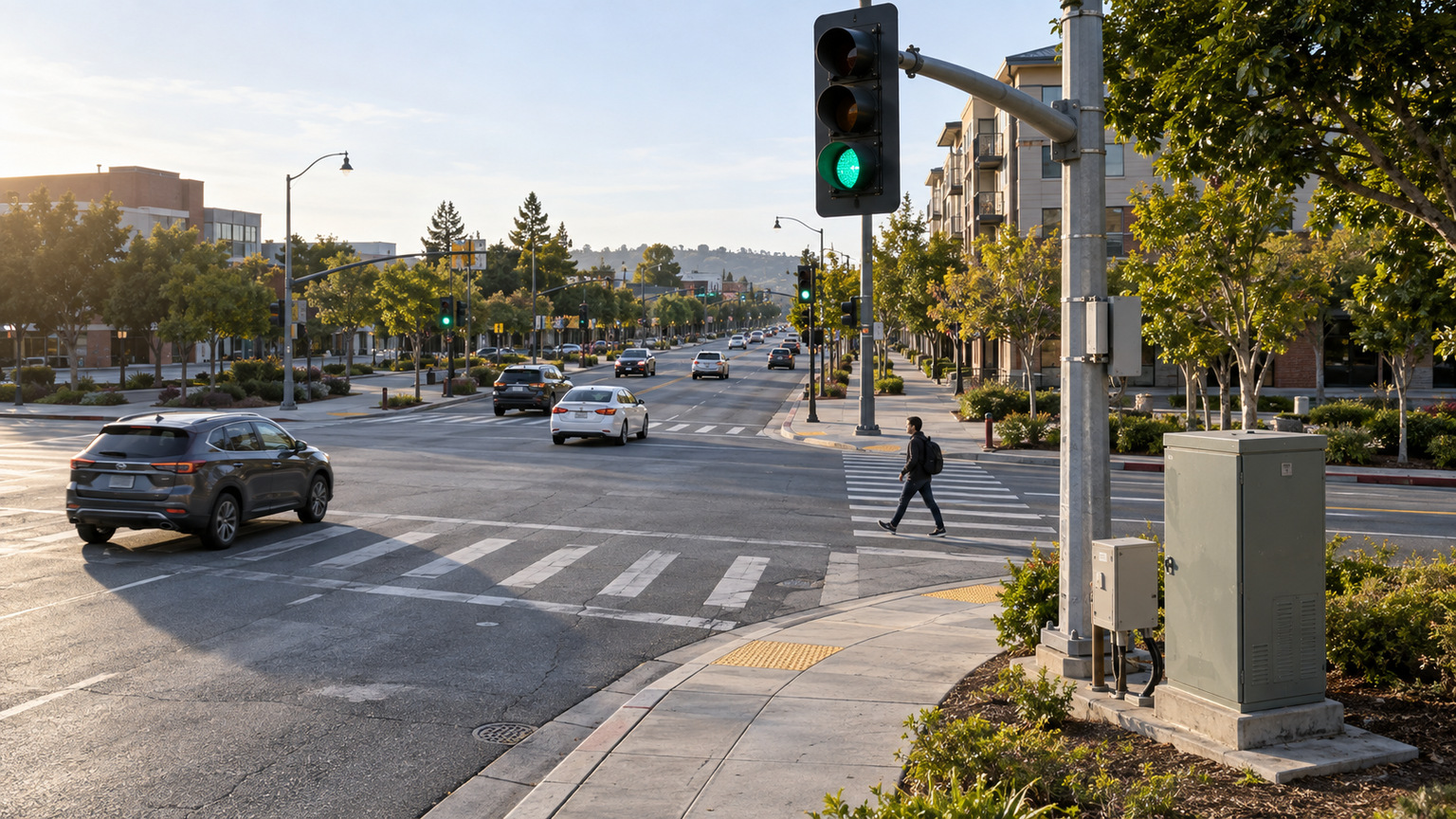


A replacement request often begins with four words: “We need a 16-inch pedestrian signal.” That is enough to start a conversation, but it is not enough to order the correct module. The number does not tell a buyer whether the existing head takes a 16 × 18-inch face, whether its inside depth accommodates the new assembly, whether the approved display has a countdown, or whether the cabinet supplies 80–135 Vac rather than a lower-voltage DC output.
The consequence is familiar to agencies and distributors: a module reaches the field that looks approximately right on a catalog page but cannot be accepted in that head, on that circuit, under that contract. A second site visit then costs more than the missing dimensional check would have.
My approach is to treat “16-inch” as an index term, then resolve three decisions in order: What must pedestrians see? What physically fits the head? What exact electrical and approval evidence matches the selected model? This article turns those decisions into a field survey and submittal guide. It uses published Frontier and LEOTEK pedestrian products as examples, without assuming the examples are interchangeable or approved by every agency.
What the “16-inch” label actually identifies
Manufacturers commonly use a nominal class name to help buyers find a pedestrian display family. It is not a universal statement of outside cabinet width, lens opening, body depth, or digit height. For example, the Frontier 430 combined hand/person/countdown product lists a 16 × 18-inch lens size. LEOTEK’s SPC pedestrian and countdown page also lists 16 × 18 inches for its lens and separately describes a 9-inch countdown digit height. Those are different measurements serving different questions. Do not use the 9-inch digit figure as the head’s opening dimension, or treat “16-inch” as proof of a particular outer envelope.
The first drawing a retrofit buyer should request is the current dimensional drawing of the exact model and options. The second is the installed head or the project’s approved head drawing. Compare them feature by feature. A nominal face match can conceal a deep rear enclosure, a projecting connector, a different gasket seat, or a mounting boss that does not align with the existing door. Where the new project includes the head as well as the insert, the matching exercise shifts to the complete assembly, pole mounting, visibility, and maintenance access.
| Field or drawing measurement | Why it matters | Evidence to obtain |
|---|---|---|
| Visible face or lens window | Determines the specified display format. | Manufacturer drawing with the dimension reference clearly identified. |
| Overall body width and height | Must clear the housing cavity, door, retaining hardware, and any visor interface. | Exact model envelope and field measurement of the receiving head. |
| Body depth and rear projection | Can interfere with the head backplate, door closure, conduit, or wiring. | Side view plus usable cavity depth. |
| Gasket and mounting points | A face that fits the opening may still fail to seat or seal properly. | Mounting detail and installation instructions. |
| Termination and lead clearance | Determines whether wiring reaches safely without an unapproved adapter. | Terminal option, wire length, connector location, and cabinet details. |
| Digit or symbol area | Determines what the pedestrian can actually read. | Model-specific symbol and countdown dimensions and applicable optical evidence. |
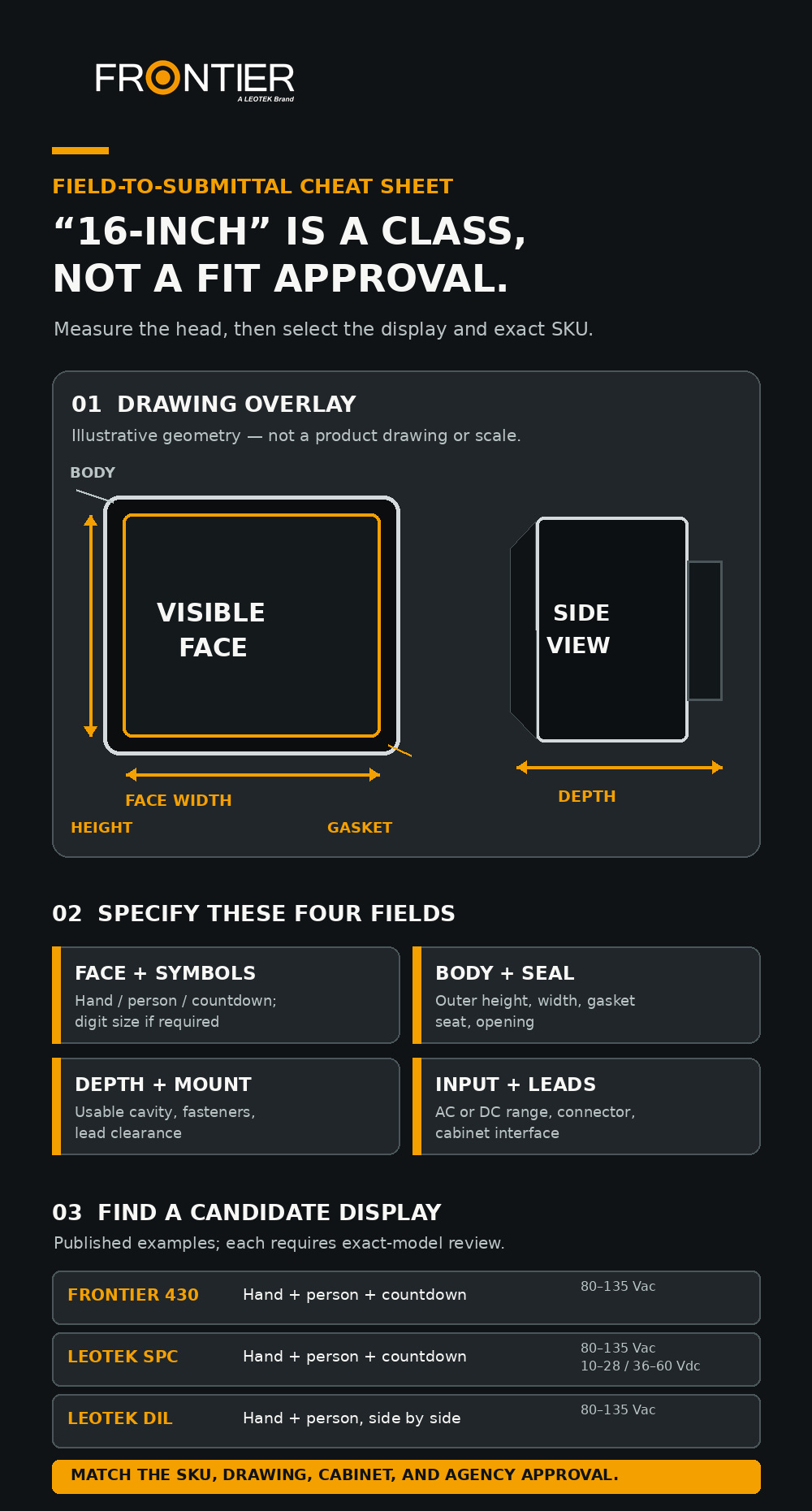
Practical field note: photograph the head front, open-door interior, label, rear clearances, terminations, and pole orientation with a scale or field measurement. Keep those observations tied to an intersection and crosswalk identifier. A photo without the catalog label and measured clearances is a useful memory aid, but a weak procurement record.
Decide the display before choosing the family
A pedestrian signal may require an UPRAISED HAND, a WALKING PERSON, countdown digits, or a particular combination and physical arrangement. A 16 × 18-inch label alone says nothing about which of those elements are present. Confirm whether the project calls for a combined display, a side-by-side hand/person arrangement, or a separate countdown unit. Then state whether a countdown is mandatory, optional, already provided elsewhere in the head, or prohibited by the approved plans.
The current Frontier portfolio provides distinct starting points:
| Published option | Display described on its page | Published input | Selection question |
|---|---|---|---|
| Frontier 430, 16 × 18-inch combined display | Hand, person, and countdown together | 80–135 Vac | Does this exact combined arrangement match the head, controller, and agency approval? |
| LEOTEK SPC, 16 × 18-inch pedestrian/countdown | Hand, person, and countdown; the product page cites 9-inch digits | 80–135 Vac, 10–28 Vdc, or 36–60 Vdc variants | Which voltage, switch option, and full model number are required? |
| LEOTEK DIL, 16 × 18-inch side-by-side | Hand and person side by side; its page does not list integrated countdown | 80–135 Vac | Does the project need a side-by-side display without an integrated countdown? |
This table is a selection map, not an equivalency approval. Frontier 430 is the primary Frontier-branded pedestrian family; SPC and DIL are LEOTEK-branded complementary options. A product may share a 16 × 18-inch class with another and still differ in face layout, switch options, supply voltage, installation geometry, documentation, and approved-list status. The Frontier pedestrian category and product overview show where to begin. Final selection requires the actual part number and current technical record.
I would ask the project engineer to mark a sketch of the desired display with the hand, person, and digits in their intended locations. That one drawing is more productive than a quote line reading “16-inch LED ped signal.” If the project calls for countdown-only in an existing assembly, verify that format separately; do not assume a combined module will fit the same space or deliver the same control behavior.
Separate countdown size from module size
An agency may specify a countdown digit height because legibility across a particular crossing matters. That dimension should appear in the submittal independently from face size and housing fit. LEOTEK’s 80–135 Vac SPC specification sheet calls out 9-inch digit height. It does not follow that every 16-inch pedestrian module has 9-inch digits. Ask for a dimensioned front view of the proposed SKU and the optical requirements that apply to those digits.
Display size also should not become a shortcut for claims about visibility. What a person perceives depends on the symbol and numeral shape, luminous intensity and color, distribution and uniformity, viewing location, glare, mounting height, and site geometry. A larger face can help meet an intended design, but its nominal dimension alone cannot establish performance for a wide crossing. The contract’s cited ITE pedestrian signal specification, any applicable tests, and the engineer’s site design supply the relevant basis. Avoid claims such as “visible from any distance” or “compliant at every intersection” when only a face size is known.
Likewise, a countdown display is one part of an operating sequence, not a clock the module independently sets for the crossing. Confirm how the proposed model interfaces with the controller and how the agency intends the countdown to be displayed during the pedestrian change interval. LEOTEK’s SPC AC sheet lists a -SW option that can turn countdown digits on or off and a -DS option with user-selectable settings. Those suffixes affect what is actually ordered. A buyer should document the option state and obtain installation instructions, rather than rely on the photographed face in a brochure.
Check voltage and termination at the same time
A common specification gap is to approve a pedestrian face by its appearance while leaving the cabinet output unresolved. Frontier’s cited 430 combined display is published for 80–135 Vac. The SPC family page lists AC and two DC ranges, and LEOTEK publishes separate 10–28 Vdc, 36–60 Vdc, and AC sheets. Those are not a single universal power input. Confirm the actual controller/cabinet circuit, available voltage under normal and backup operation, frequency for AC equipment, wiring and termination, and any interface limitations in the current manufacturer instructions.
The difference is measurable even within one family. Published SPC sheets identify model numbers TSL-PED-16-SPC-V1 for the AC example, TSL-PED-16-SPC-B1 for the 10–28 Vdc example, and TSL-PED-16-SPC-L1 for the 36–60 Vdc example. These historical sheet identifiers illustrate how a voltage change becomes a different procurement item; verify current orderability and revisions with the supplier. Do not simply choose “SPC” and let the receiving team discover which one was delivered.
The termination question is equally practical. A model page may list several terminal styles, but the quoted option still must match the existing field wiring and approved installation method. Ask whether any adapter is included or separately ordered, and whether the usable depth changes once leads are dressed. A retrofit should be evaluated as an electrical and mechanical installation, not a replacement lens on a spreadsheet.
What the standards answer—and what they do not
The FHWA MUTCD, 11th Edition with Revision 1 is the current federal publication for traffic-control devices. Its pedestrian-signal provisions address application and operation in the traffic system. They do not confer a manufacturer product certificate or tell a buyer that every item in a 16-inch category meets a specific agency’s bid. The project must identify the adopted edition, state or local supplements, and contract-specific drawings and acceptance route.
ITE publishes a separate LED pedestrian signal specification. Where a contract cites it, identify the edition and request evidence for the proposed model and configured indication. A general “ITE compliant” line on a family page is a lead for technical review, not a substitute for it. An ETL or other listing, where required, has a defined product and standard scope; an agency approved-product list is a different acceptance decision. The reviewer should be able to trace each claim to the same full order code.
For accessible crossings, the visual module is only part of the answer. The U.S. Access Board’s Public Right-of-Way Accessibility Guidelines define an accessible pedestrian signal in terms of nonvisual information and address pushbutton or passive-detection arrangements and audible and vibrotactile WALK indications where applicable. A larger display, even one with clear hand/person symbols and countdown, cannot by itself establish that the complete crossing meets those requirements. Confirm how the relevant rules apply to the project and assign the APS interface, timing, and installation review to the responsible team.
A field-to-submittal workflow I would use
- Survey the installed condition. Record intersection, crosswalk, existing head and module model, face/opening dimensions, usable cavity depth, mounts, gasket, terminations, voltage, and photographs with scale.
- Freeze the intended display. Write the hand, person, and countdown requirements, their layout, symbol or digit dimensions if specified, and how the countdown is to operate with the controller.
- Choose candidate configurations. Review Frontier 430 for its published combined AC display and selected LEOTEK SPC or DIL options where the display, voltage, or layout points that way. Obtain complete order codes, not family names.
- Overlay the drawings. Compare front and side dimensions, gasket seat, mounting and door clearance. Ask the manufacturer or distributor to identify any dimensional assumption that remains unresolved.
- Match electrical and optical evidence. Use current variant-specific sheets, wiring/installation instructions, required optical tests, listing records, and applicable approval documents. Resolve exceptions in writing.
- Review the whole crossing. Have the agency or qualified engineer verify controller timing, cabinet monitoring, APS scope, approved-product status, and commissioning procedure under the contract.
- Control delivery. Put the accepted part number and option state on the purchase order; inspect the received label and physical assembly against the submittal before field installation.
That workflow is intentionally in the order a project can act on it. A salesperson cannot resolve a head’s usable cavity by quoting a performance number. An engineer cannot confirm controller compatibility from a front photograph. A receiving clerk should not have to choose between two switch suffixes that the approved submittal never identified.
Two short selection examples
Consider a maintenance team replacing a combined hand/person/countdown display in an existing 16 × 18-inch head supplied by an 80–135 Vac circuit. The Frontier 430 combined model is a relevant candidate on its published face format, indications, and input range. The team still needs the current full order code, physical drawing, wiring detail, and agency approval. A LEOTEK SPC AC model might also enter the review where allowed, but its option suffix and fit must be checked on their own merits. Choosing solely on the shared face format would leave the important questions unanswered.
Now consider a site whose approved cabinet design specifies a 10–28 Vdc pedestrian output. The published Frontier 430 example above is an AC product; it is not transformed into a DC model by using a different quote description. LEOTEK’s SPC 10–28 Vdc specification provides a possible starting point, with a separate model identifier and ratings. Whether that option is suitable still depends on the complete crossing design, housing fit, field wiring, contract, and agency acceptance. These examples show why the sequence of decisions matters more than a product-family shortcut.
What buyers should watch next
I expect agencies to become less tolerant of vague size labels as they standardize asset inventories and plan mixed cabinet upgrades. A record that says “16-inch pedestrian LED” is too thin to support a future replacement, because it omits the display arrangement, voltage, options, and document revision. A structured record with the complete SKU and housing identifier can support repeat orders, spare inventory, and a cleaner transition between old and new equipment. That is an inference about useful procurement practice, not a claim that the visual module itself is networked or reports its dimensions to a management platform.
For product marketing, the opportunity is to make the difference visible: publish a dimensioned drawing, a clear indication map, a voltage-specific part-number table, and a concise fit checklist for each configuration. Those materials help buyers move from an approximate search term to a defensible submittal. They are also more useful to an AI-assisted product comparison than a generic paragraph about brightness and safety, because the attributes can be matched to a project requirement without guesswork.
Have an existing pedestrian head to replace? Contact Frontier with the head label, field dimensions, cabinet voltage, required display, and agency specification. We can help identify the appropriate Frontier 430 or selected LEOTEK option and the exact documents your reviewer needs.
References (APA 7th edition)
Federal Highway Administration. (2025). Manual on Uniform Traffic Control Devices for Streets and Highways: 11th edition with Revision 1. U.S. Department of Transportation. https://mutcd.fhwa.dot.gov/kno_11th_Editionr1.htm
Frontier. (n.d.). Frontier pedestrian signal 16″ × 18″ 80–135 Vac ITE hand/person with countdown. LEOTEK. https://frontier.leotek.com/product/frontier-pedestrian-signal-16×18-inch-80-135vac-ite-hand-person-with-countdown/
Institute of Transportation Engineers. (n.d.). Specifications. https://www.ite.org/technical-resources/topics/standards/specifications/
LEOTEK. (n.d.). DIL Series 16″ × 18″ pedestrian signal module, hand and person side by side. https://leotek.com/product/ped-signal-dil-dp-16×18/
LEOTEK. (n.d.). SPC Series 16″ × 18″ pedestrian and countdown signal module. https://leotek.com/product/spc-series-16-with18-pedestrian-countdown-signal-module/
LEOTEK Electronics USA. (2017). SPC Series LED 16-inch pedestrian signal module: 48 V series specification sheet [PDF]. https://leotek.com/wp-content/uploads/2024/09/spc_16-inch_pedestrian_signal_module_48v_Spec_Sheet.pdf
LEOTEK Electronics USA. (2018). SPC Series LED 16-inch pedestrian signal module: 80–135 Vac specification sheet [PDF]. https://leotek.com/wp-content/uploads/2024/09/SPC_16-Inch_Pedestrian_Signal_Module_80-135Vac_Spec_Sheet_11-13-18.pdf
LEOTEK Electronics USA. (2023). SPC Series LED 16-inch pedestrian signal module: 10–28 Vdc specification sheet [PDF]. https://leotek.com/wp-content/uploads/2024/05/SPC_16-Inch_Pedestrian_Signal_Module_10-28Vdc_Spec_Sheet_231115.pdf
U.S. Access Board. (n.d.). Public Right-of-Way Accessibility Guidelines. https://www.access-board.gov/prowag/complete.html