
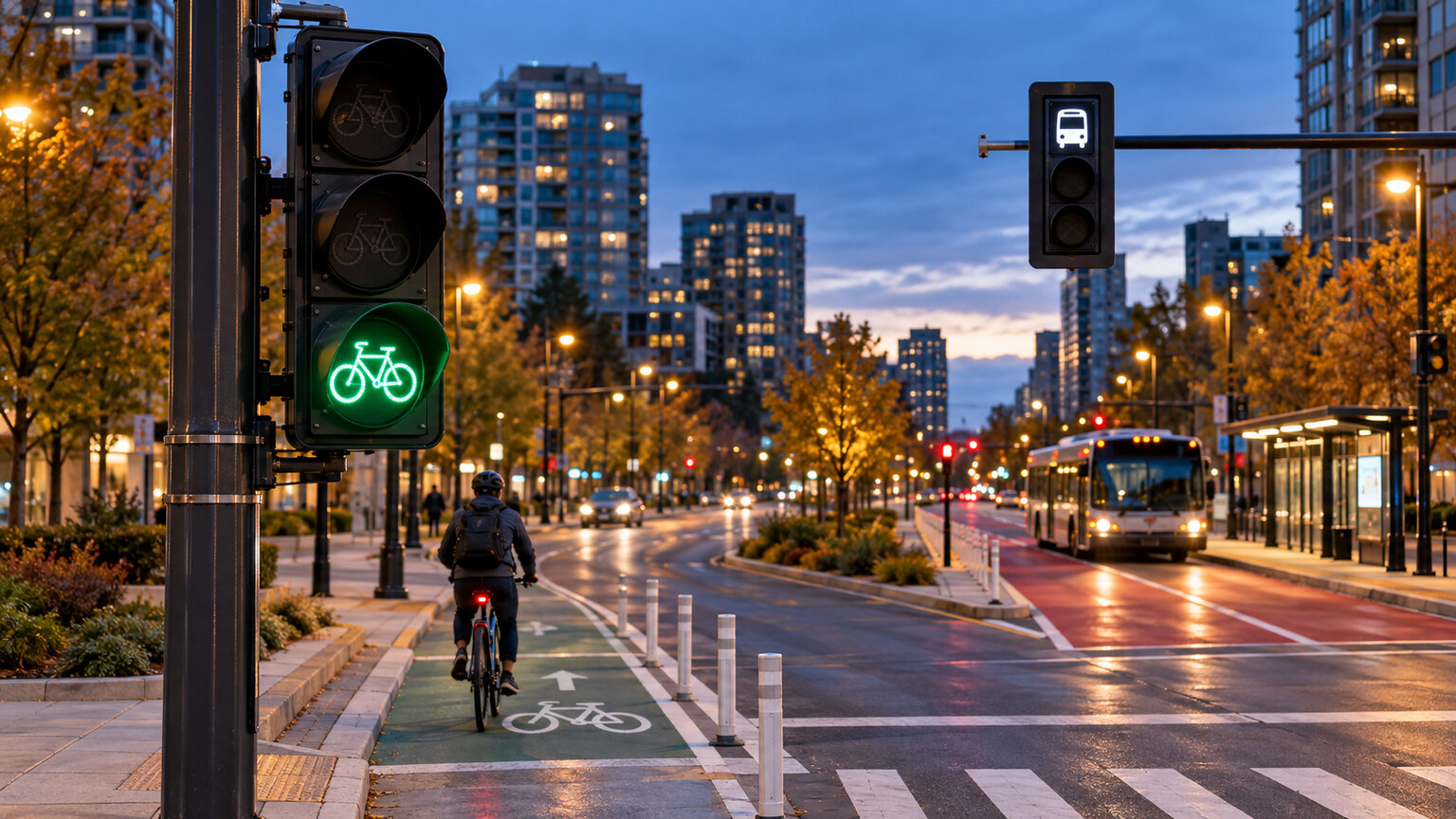
Replacing a bicycle or bus indication is a small part of a larger intersection decision. The LED module must match the intended symbol and the existing assembly, while the agency or engineer remains responsible for signal operation, visibility, and acceptance. A purchase request that says only “12-inch LED signal” leaves out the information that makes the replacement verifiable.
FHWA’s Signalized Intersections: Informational Guide, Second Edition considers bicycle and transit users alongside motorists and pedestrians. Its Chapters 4, 5, and 9 discuss bicycle facilities, transit facilities, signal displays, and intersection treatments. The guide was published in 2013 and refers to older editions of standards; for a current U.S. project, check the official MUTCD 11th Edition with Revision 1, applicable state supplements, and the owner’s approved drawings.
Start with the indication and the project drawing
A bicycle symbol and a bus symbol identify different movements. Confirm who the display is intended to control, its color, the approach and lane, and whether the scope is a like-for-like module replacement or a change to signal operation. A new or revised movement requires an engineering review of placement, phasing, conflicts, signing, and detection. An LED module purchase by itself does not establish that the intersection design meets those requirements.
The FHWA guide emphasizes how a bicycle facility enters and passes through an intersection (Section 4.7) and how transit facilities near an intersection affect operations (Sections 4.8 and 9.3). Its signal-display discussion (Section 5.2) connects the type and location of a signal head to visibility and agency policy. Those are useful questions for a project briefing, even though the current MUTCD and agency documents govern the actual installation.
Build a model-level replacement record
Record the existing equipment before selecting a replacement. Photograph the illuminated indication and the rear label, then retain the existing full part number. A model suffix can identify a size, color, or other configuration that is lost when a requisition uses only a product family name.
| Check | What to record | Why it matters |
|---|---|---|
| Display | Bicycle or bus symbol; red, yellow, or green | Confirms the movement and visible message |
| Physical fit | Signal-face size, housing opening, lens, and mounting arrangement | Nominal diameter alone does not confirm the installed fit |
| Electrical interface | Input range, frequency, terminals, and existing controller connection | Matching a voltage range alone does not confirm a complete replacement |
| Project acceptance | Current agency specification, approved model, and submittal version | Approval may apply to a particular model or configuration |
| Scope of work | Module only, signal head, or change in timing and layout | Determines who must review and commission the change |
Apply the published IL6 details carefully
The LEOTEK IL6 bicycle module page links to a manufacturer specification that lists 8-inch and 12-inch bicycle indications, red/yellow/green model numbers, 80–135Vac input, and tinted lens only. The specification is dated 2017 and says its information can change, so verify the latest controlled sheet and full ordering code for the project. The IL6 bus module page lists a 12-inch bus indication and separate bus model numbers. Do not treat those codes as interchangeable with the bicycle codes or with a circular ball module.
For a bicycle unit, the published IL6 bicycle specification PDF is a useful starting document. Request a current version and any model-specific approval or declaration required by the agency. Product pages are selection aids; they do not replace a project submittal.
Separate the maintenance order from an operational change
If the work preserves the same indication, signal head, location, and operating plan, the team can concentrate on the exact replacement configuration, safe installation, and functional verification under the owner’s procedure. If the request changes a bicycle movement, adds a bus-only display, relocates a head, or alters phasing, bring the traffic engineer and agency into the review before ordering. FHWA’s guide treats intersection safety and operation as connected; a brighter or newer module does not by itself solve a conflict created by layout or timing.
Where a federal funding condition applies, keep the procurement record separate from the engineering acceptance record. Our Buy America traffic signal procurement guide explains why project obligation date, delivery unit, and model-specific manufacturing evidence must be checked independently of the display choice.
Questions buyers ask
Can a bicycle module be used as a bus or circular signal?
Do not assume so. The symbol, model number, applicable display requirements, and project drawing differ. Confirm a proposed substitution with the agency and the current manufacturer documentation.
Does 80–135Vac mean the new module fits the existing signal head?
No. Compare size, lens, mounting, housing, terminals, electrical interface, and the exact approved model. Voltage is one field in the review.
Does the FHWA 2013 guide set today’s signal requirements?
It is background guidance on intersection evaluation. For current requirements, use the applicable MUTCD 11th Edition with Revision 1, state and local provisions, and project documents.
Source notes
- FHWA, Signalized Intersections: Informational Guide, Second Edition (2013), Sections 4.7, 4.8, 5.2, and 9.3.
- FHWA, MUTCD 11th Edition with Revision 1 (current official edition).
- LEOTEK, IL6 Bicycle Indication specification (2017; confirm current revision).
Cover image is a conceptual illustration, not a product photograph or approved intersection layout.