
Johnny Wu | Industry perspective | September 25, 2026
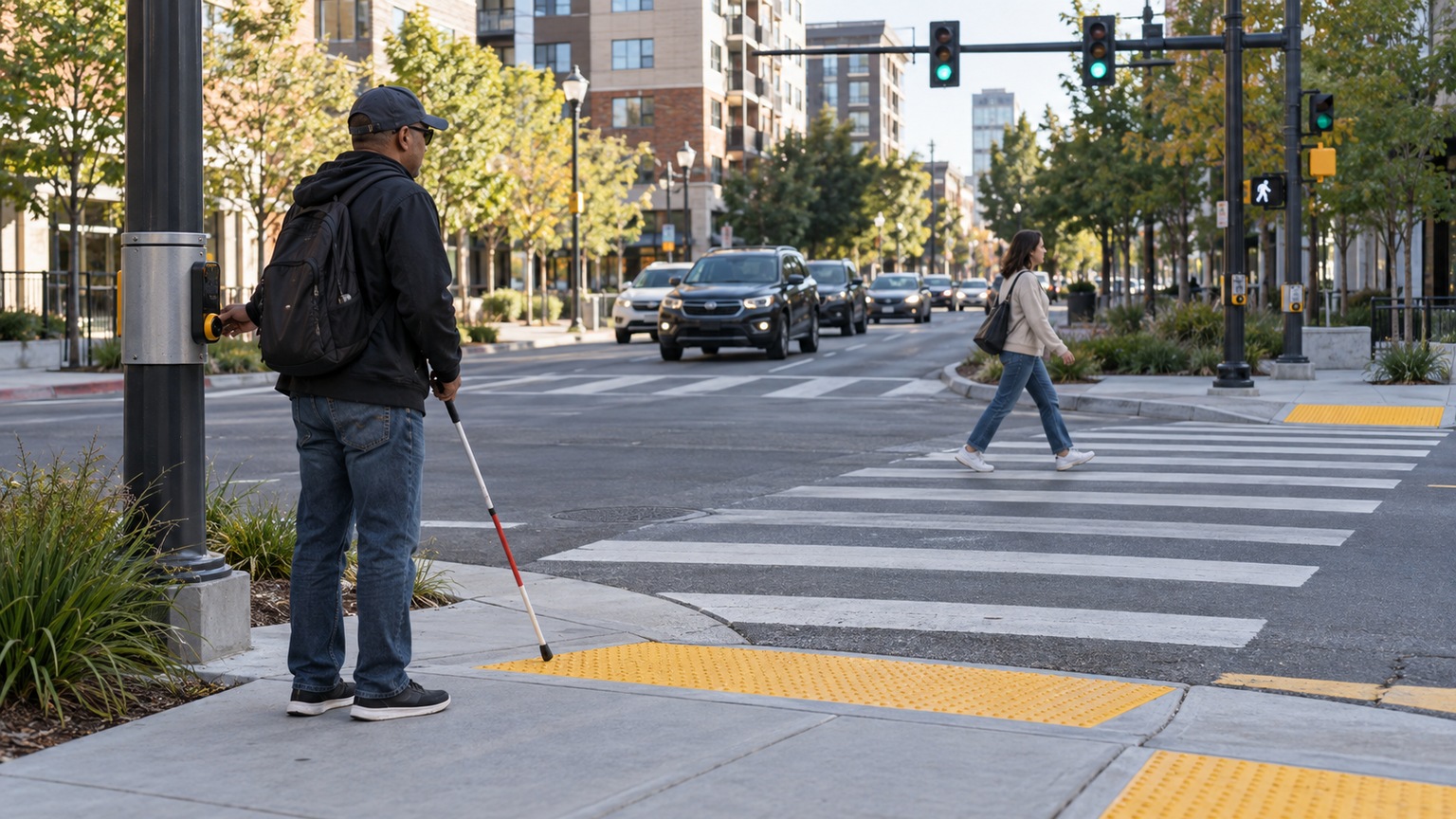
Recent pedestrian signal projects offer a useful lesson for the traffic signal industry: an accessibility upgrade can create a requirement for several different products, each with a specific job. Countdown displays communicate visual timing information. Accessible pedestrian signals, or APS, communicate through nonvisual indications. Signal timing and the physical crossing environment determine how those elements work together.
For Frontier, this distinction creates a clear product-positioning opportunity. Its pedestrian signal modules belong in the discussion about the visual indications specified for a crossing. The commercial value comes from explaining that role accurately and helping buyers identify the right module within the broader design.
My reading of recent U.S. projects is that suppliers should prepare for conversations about coordinated retrofits, including retained equipment and changes to pedestrian timing. That is a more specific opportunity than treating every accessibility announcement as an order for a new display. The examples below are U.S. projects; their technical requirements should not be assumed to apply unchanged in Canada.
Recent projects show how agencies are packaging the work
On August 31, 2026, New York City published a solicitation titled Retrofit of Signalized Intersections to Incorporate Accessible Pedestrian Signals, under procurement number 84126B0007. The public notice identifies a competitive sealed bid for construction services, with a listed deadline of September 30, 2026. It establishes an active procurement step, rather than a completed installation or an awarded equipment order (New York City Department of Transportation [NYC DOT], 2026).
Connecticut provides a more detailed view of the equipment mix. In July 2026, CTDOT announced a public meeting for APS upgrades in Southern Connecticut. Its project page describes pedestrian pedestals, APS pushbuttons, countdown signal heads, sidewalk ramps, and leading pedestrian intervals. The approximately $6 million project is expected to enter construction in 2028, subject to funding, right-of-way acquisition, and permits. The estimate covers the project, not a countdown-module purchase budget (Connecticut Department of Transportation [CTDOT], n.d., 2026).
The Southern Connecticut project description is especially instructive because it names countdown heads and APS pushbuttons separately. They address complementary parts of the pedestrian experience. For a supplier evaluating the opportunity, the next questions concern the actual plans, approved products, quantities, and delivery schedule.
I would track these two examples at different stages. New York City's notice calls for a review of the solicitation documents and current addenda. Connecticut's planned construction schedule points toward design coordination and specification support. Neither source establishes that Frontier has been selected. Both indicate where a visual-module supplier can look for a relevant role in a larger intersection upgrade.
Understand what a countdown display communicates
The current FHWA Manual on Uniform Traffic Control Devices, the 11th Edition with Revision 1 dated December 2025, provides the technical reference for this discussion. Section 4I.04 describes countdown displays as information about the seconds remaining in the pedestrian change interval, during the flashing upraised-hand indication. It requires that display for pedestrian signal heads at crosswalks where the change interval exceeds seven seconds; for seven seconds or less, it permits one (Federal Highway Administration [FHWA], 2025, § 4I.04).
The same section specifies that the countdown begins with the pedestrian change interval and is not displayed during the WALK interval. This matters for both engineering and communication. Describing a countdown as the number of seconds remaining to start crossing would misrepresent its function. Product copy should explain the indication in terms consistent with the signal sequence.
For a buyer, a countdown module therefore needs to be evaluated as part of the installed visual signaling arrangement. The questions include which indications are present, where the display is positioned, which crosswalk it serves, and how it behaves with the configured timing. Choosing a nominal display size does not answer all of those questions.
I would also distinguish the display's role from the controller's role. The presence of countdown digits does not demonstrate that the device detects pedestrians, selects an appropriate crossing duration, or automatically extends a phase. Those capabilities require their own evidence and system design. Keeping the distinction explicit helps Frontier explain a visual module's actual contribution without attaching unsupported functionality to it.
APS provides information through another channel
MUTCD Chapter 4K describes APS and detectors as providing information in nonvisual formats. Section 4K.03 requires both audible and vibrotactile WALK indications. Other provisions address matters such as the crossing served by each device, pushbutton location, directional information, and locator tones (FHWA, 2025, §§ 4K.01–4K.04).
A brighter or larger visual display cannot, by itself, provide those audible and tactile functions. Likewise, a pushbutton on a pole should not be assumed to provide APS functionality merely because pedestrians use it to request a crossing. The proposed equipment and its configuration need to establish what information it delivers.
For a specification review, I would separate four responsibilities:
- Visual indications. Identify the hand, walking-person, and countdown displays required for each crossing, including the selected module and housing arrangement.
- Accessible information. Identify the APS equipment and the required audible, vibrotactile, locator, and directional functions under the applicable design.
- Signal operation. Document the intended phases and timing, including how the pedestrian indications are coordinated with vehicle movements.
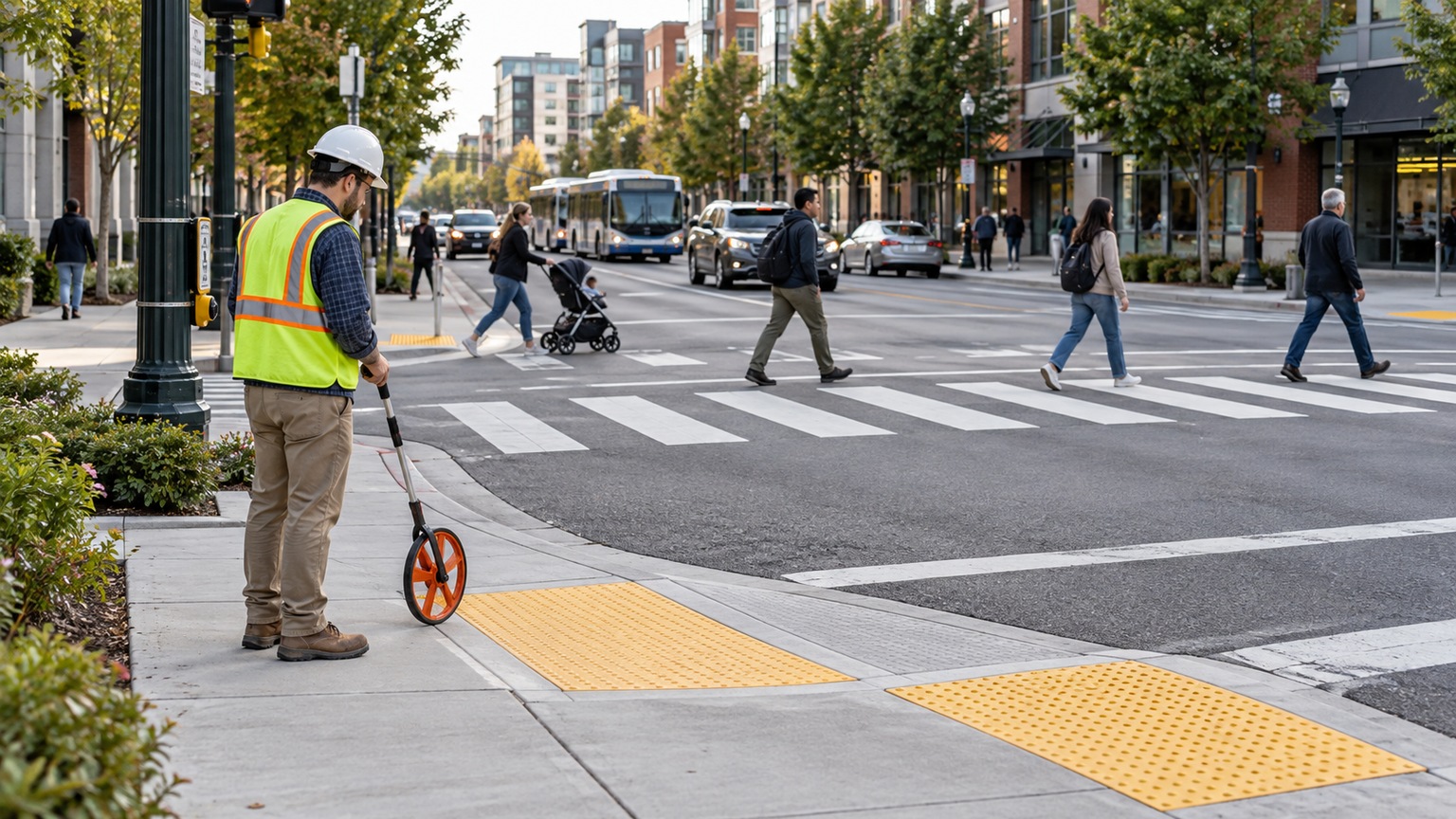
- Physical access. Review how pedestrians approach the crossing, reach the controls, and use the ramps and waiting areas included in the project.
This is a recommended way to organize the review, not an additional regulatory classification. It helps a contractor or distributor identify which supplier is responsible for each function and where coordination is required. It also avoids asking a visual-module data sheet to prove the performance of the entire crossing.
Leading pedestrian intervals make coordination more important
A leading pedestrian interval, or LPI, gives pedestrians a WALK indication before the release of specified parallel vehicle movements. The MUTCD explains why accessible information matters in that situation: pedestrians with vision disabilities need to recognize the crossing opportunity when the usual audible cue from vehicles starting to move is absent. It also notes the potential problem of a pedestrian beginning at the onset of vehicle movement when accessible features are missing (FHWA, 2025, § 4I.06).
For the industry, the practical implication is that a timing change can create a coordination task even when some physical signal equipment is retained. A project team should establish how the visual WALK indication and the accessible WALK indication correspond to the intended pedestrian phase. The countdown then serves its defined role in the pedestrian change interval.
My recommendation is to make that sequence part of the design discussion and acceptance review. Ask the engineer to identify the required operation, then ask the equipment suppliers for the relevant interface and configuration information. A product's inclusion in the same equipment package is not evidence that every operating condition has been evaluated.
This is also why I would avoid an unsupported “works with all APS systems” claim for a Frontier module. Compatibility should be assessed for the actual controller, wiring, APS equipment, module, and intended sequence. A clearly defined compatibility question is more useful to an integrator than a broad assurance that leaves the installation conditions unstated.
Crossing upgrade scope at a glance
These elements solve different user and operational needs. Confirm the applicable design and agency requirements before specifying hardware.
| Element | Question for the project team | Selection or test record |
|---|---|---|
| Visual indication | What size, legend, housing, and viewing conditions are required? | Approved display and module schedule |
| Countdown display | How must the displayed time follow the programmed crossing sequence? | Controller compatibility and field test |
| Accessible pedestrian signal | What audible, vibrotactile, and locator functions are specified? | APS design and acceptance record |
| Leading pedestrian interval | How will pedestrian and turning movements be coordinated? | Timing plan and observed commissioning result |
Where Frontier fits in the visual signal scope
The Frontier 12 × 12 countdown pedestrian signal page provides an entry point for this product family. For a concrete model reference, LEOTEK's July 23, 2025 specification sheet, hosted by Wisconsin DOT, lists 430-7773-001XWI as a countdown module and 430-6772-001XWI as a hand/person module. The sheet identifies a WIDOT configuration and separately lists the indications for those two part numbers (LEOTEK Electronics USA LLC, 2025).
That distinction is useful during replacement planning. A purchaser should preserve the complete part number and verify whether the required item provides countdown digits or hand/person indications. The presence of two products on one sheet does not make them interchangeable. Nor should the XWI configuration be generalized to every agency's requirements.
For another arrangement, Frontier lists a 16 × 18 pedestrian signal with hand/person and countdown indications (Frontier, n.d.). This is a relevant product family to review when the project calls for that visual configuration. Selection still requires the current controlled specifications, installation information, exact model, and agency requirements.
Neither of these product references establishes that the visual module itself supplies the audible and vibrotactile functions described in Chapter 4K. Their role in this article is the visual signaling portion of the crossing. That boundary gives Frontier a credible place in an APS-related project without presenting its countdown display as a complete accessibility solution.
What buyers should establish before choosing a module
I would begin with a crossing inventory rather than a list of nominal sizes. Record the existing housing, displayed indications, complete module identifiers, mounting arrangement, controller information, and the equipment intended to remain. Photographs can support the record, but they should not replace model labels or installation documents.
Next, identify the change the project is intended to make. Is the work adding countdown information, replacing deteriorated visual modules, introducing APS, changing timing, or combining several of those tasks? The answer determines which parts of the existing installation must be reviewed. Two crossings with similar-looking heads may need different scopes of work.
For the proposed Frontier module, I would request confirmation of the physical fit, electrical requirements, connections, and documented operating behavior relevant to that installation. I would also verify the agency's model acceptance requirements. These are selection questions; this article does not establish a universal fit or approval for either product family.
The contractor should then identify the party responsible for coordinating the visual equipment with APS and controller operation. If responsibilities are split among suppliers, the unanswered interface questions should be visible before the purchase is finalized. A complete equipment list can still contain an unresolved coordination problem.
Finally, agree on the required commissioning and handover records. My recommended record would associate each installed model with its crossing, configuration, applicable acceptance checks, and maintenance contact. The purpose is to give the agency a usable record when a module is replaced or the timing is later revised.
Test the crossing sequence and retain the result
Consider a hypothetical retrofit that retains the existing controller while replacing visual modules and introducing new APS equipment. Every device could power on, yet the project team would still need to verify whether the indications correspond to the correct crossing and the intended phases. An illuminated display is only one part of that review.
The acceptance process should follow the approved design and agency procedures. My recommendation is to document the observed visual and accessible WALK indications, the pedestrian change interval, and the countdown behavior under the operating conditions included in the project. Where timing varies, the engineer should identify the conditions that need to be checked.
This recommendation has a specific technical basis. MUTCD Section 4I.04 cautions engineers about changing pedestrian change intervals where the countdown logic operates in a separate timing device independent of the traffic signal controller. It also addresses countdown behavior when a change interval is interrupted or shortened during transition to preemption (FHWA, 2025, § 4I.04).
The lesson for a module supplier is to provide accurate operating documentation and to state the conditions under which it applies. For an agency, it is to retain the commissioning record alongside the timing information. Later changes should trigger a review of the affected equipment and behavior, rather than an assumption that the original acceptance remains sufficient.
What I expect suppliers to encounter next
The recent project examples suggest a commercial environment in which visual-module suppliers will be asked to explain how their products fit within work led by accessibility and pedestrian-safety objectives. I expect requests for clearer product boundaries, replacement identification, and coordination information to become more valuable in these conversations. This is my interpretation of the project scopes, not a measured forecast of national sales growth.
For manufacturers and distributors, the response should start with the information a specifier needs to make a decision. Organize the product range by actual indication and configuration. Make the controlled documentation easy to locate. Explain which questions belong to the module supplier and which require the engineer, APS provider, or controller supplier.
There is also a reason to involve maintenance teams early. They will inherit the installation after the construction team leaves. A record that identifies the exact visual module, its corresponding crossing, and the accepted configuration can make later fault investigation more focused. I would ask those teams what information they repeatedly have to reconstruct and include it in the handover requirements.
I would not attribute the safety outcome of a coordinated intersection project to one display component without supporting evidence. Connecticut's scope combines several interventions. Any assessment of results would need to account for what was installed, how it operated, and the evaluation method. Product marketing should remain specific about the function being supplied.
Turn the distinction into useful buyer communication
For Frontier's B2B content, the most useful message is a clear explanation of visual pedestrian signaling within a coordinated crossing upgrade. A buyer searching for countdown modules should quickly understand the indication provided, the available configuration, and the information needed for selection. An APS-related inquiry should be directed to the visual-module scope while the separate accessibility functions remain explicit.
I would support that message with a short selection checklist and links to the corresponding product pages and specifications. Sales follow-up can then begin with the existing equipment and intended project changes. That is a stronger basis for a technical conversation than asking only whether the customer wants a “pedestrian safety upgrade.”
The developments I would monitor are revised project plans, approved-product requirements, and agency acceptance procedures. A public meeting announcement signals a design-stage opportunity; a solicitation signals a procurement task; an award or completed installation requires separate evidence. Maintaining those distinctions helps the team prioritize work without overstating what the news proves.
Start with the required Frontier indication
If your project includes replacement or new installation of visual pedestrian modules, review Frontier's 12 × 12 countdown and 16 × 18 hand/person-with-countdown product families, then contact Frontier with the agency, existing housing and model, required indications, controller information, and target schedule.
Ask for the current controlled documentation and confirmation of the appropriate model for the visual signaling scope. Identify the APS equipment and timing work separately so the project team can address the interfaces. My central recommendation is to define what each device must communicate, then verify that the completed crossing delivers those indications as designed.
Related reading
To compare physical visual modules, see 12 × 12 versus 16 × 18 pedestrian signal selection. For the wider standards context, see the 11th Edition MUTCD overview.
References
Connecticut Department of Transportation. (n.d.). Project 0173-0549. Retrieved September 25, 2026, from https://portal.ct.gov/DOTSouthernCT0173-0549
Connecticut Department of Transportation. (2026, July 7). Public information meeting regarding accessible pedestrian signal upgrades in Southern Connecticut. https://portal.ct.gov/dot/ctdot-press-releases/2026/public-information-meeting-regarding-accessible-pedestrian-signal-upgrades-in-southern-connecticut
Federal Highway Administration. (2025, December). Manual on uniform traffic control devices for streets and highways (11th ed., Rev. 1). U.S. Department of Transportation. https://mutcd.fhwa.dot.gov/pdfs/11th_Editionr1/mutcd11theditionr1hl.pdf
Frontier. (n.d.). Frontier pedestrian signal 16″ × 18″ 80–135Vac ITE hand / person with countdown. Retrieved September 25, 2026, from https://frontier.leotek.com/product/frontier-pedestrian-signal-16×18-inch-80-135vac-ite-hand-person-with-countdown/
LEOTEK Electronics USA LLC. (2025, July 23). 12″ traffic pedestrian signals specification sheet. https://wisconsindot.gov/Documents/doing-bus/eng-consultants/cnslt-rsrces/tools/prods/658/6580660frontierleotek.pdf
New York City Department of Transportation. (2026, August 31). 84126B0007-84126MBTR741 retrofit of signalized intersections to incorporate accessible pedestrian signals [Solicitation notice]. The City Record Online. https://a856-cityrecord.nyc.gov/RequestDetail/20260825030