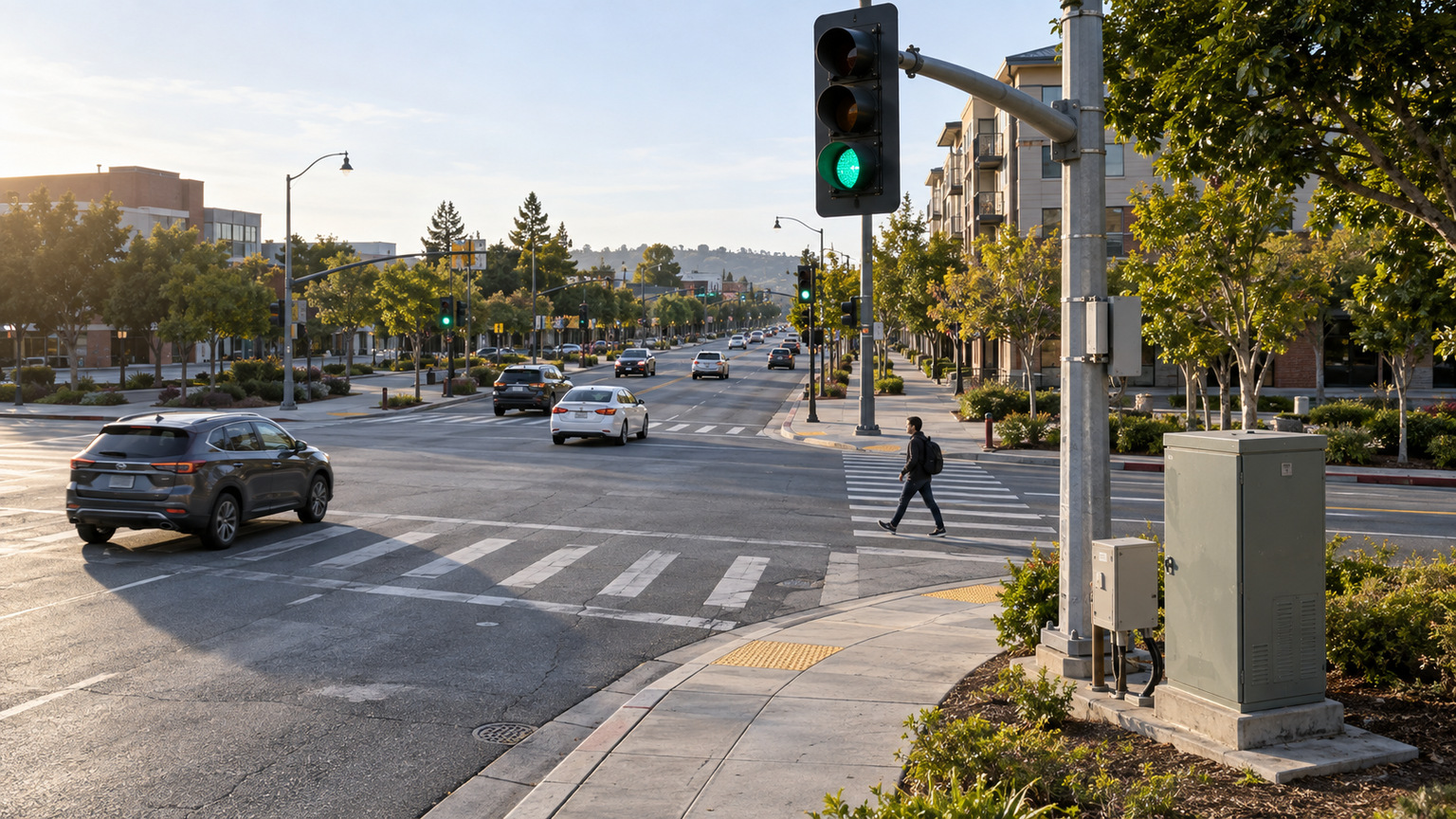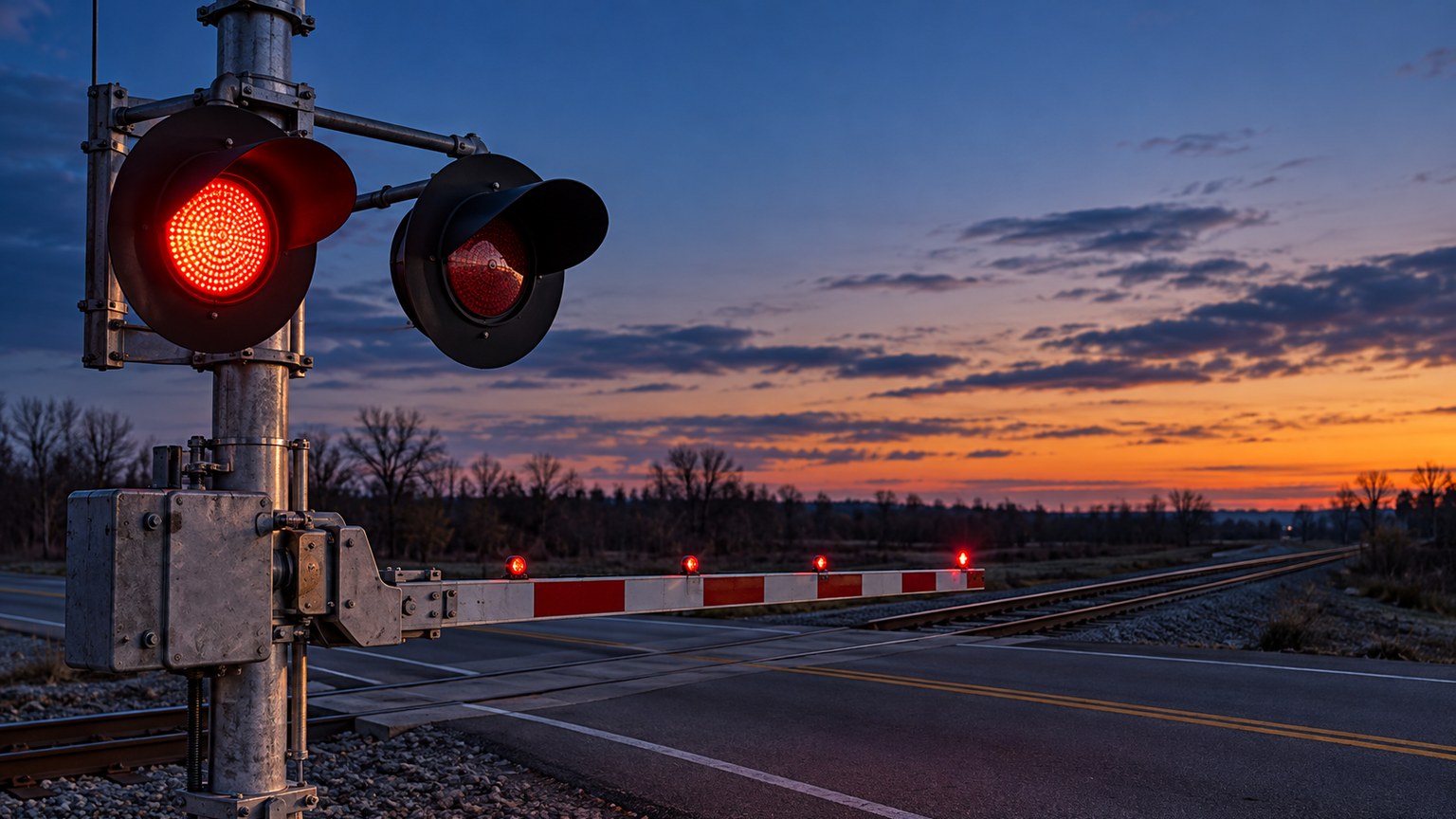

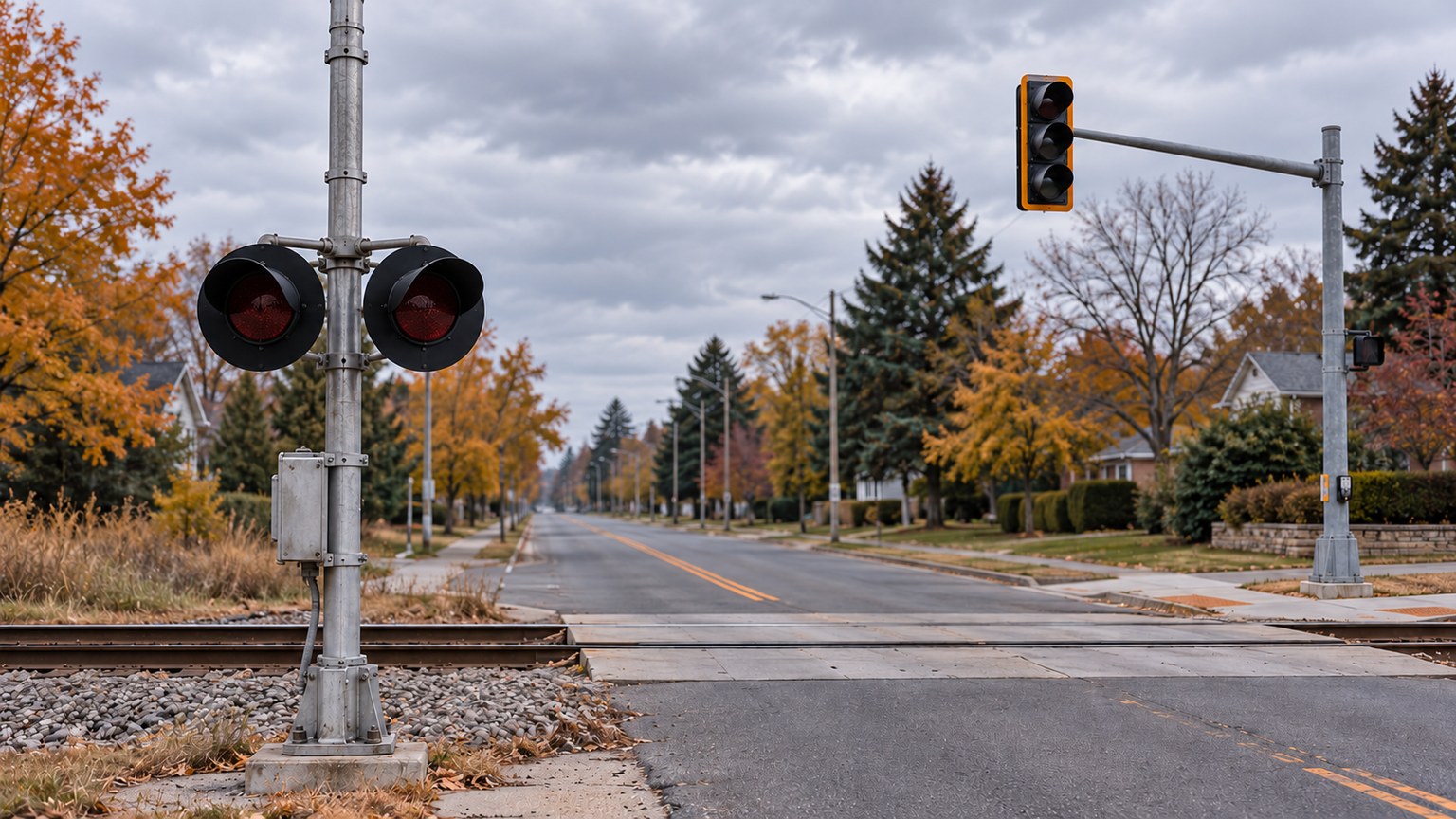
Railroad crossing traffic signal preemption is a coordination problem whenever a highway signal controls a short segment of road near the tracks. A red light downstream can form a queue across the crossing. The design review must account for the crossing warning system, the highway controller, the available storage space, train approach, and the vehicles that need to clear the track area. An LED warning lamp is one visible component of that system; changing the lamp does not configure preemption.
What does preemption do at a crossing?
When a train approaches, an interconnected grade crossing warning system can send a preemption request to the highway traffic signal controller. The controller then departs from its normal sequence to provide a track clearance interval, allowing vehicles already in the minimum track clearance distance an opportunity to move away before rail traffic arrives. The Manual on Uniform Traffic Control Devices (MUTCD) describes this as a combined system whose operating parameters must be understood together. It distinguishes advance preemption, which sends notice before the crossing warning activates, from simultaneous preemption, which sends notice at the same time. The applicable sequence and timing require site-specific engineering review; this article does not prescribe them.
For the underlying distinction between a passive crossing and active train-actuated warnings, see our passive versus active railroad crossing guide. A normal highway traffic signal should not be assumed to replace the crossing’s flashing-light signals; the MUTCD provides only limited exceptions.
When does an adjacent signal need review?
MUTCD Section 8D.09 provides guidance that a signal-controlled location 200 feet or less from a crossing equipped with flashing-light signals should have rail preemption, unless the Diagnostic Team determines otherwise. This is a review trigger with an explicit exception, not a universal installation rule. If the signal is more than 200 feet away, the same section calls for consideration of coordination and queue-management measures when queues could extend into the minimum track clearance distance. Traffic volume, vehicle mix, train frequency and speed, driveways, and downstream bottlenecks all matter. A distance measured on a plan cannot replace observing how traffic actually stores and clears.
Section 8D.09 also states a more specific standard: where crossing flashing lights are in place, highway signal faces installed within 50 feet of any rail must be preempted upon rail approach, with indications determined by the Diagnostic Team to avoid conflict. The 50-foot rule concerns signal faces and their location relative to a rail; it should not be confused with the 200-foot guidance concerning a nearby signal-controlled location. State adoption and the project authority’s requirements should be checked for the installation.
A coordination checklist for the railroad and highway agency
Use a shared, crossing-specific review before changing a controller, warning circuit, intersection phasing, or equipment load. The items below identify decisions and records, not preapproved timing values.
| Review item | Document together |
|---|---|
| Crossing and roadway geometry | Crossing ID, track and roadway layout, signal location, stop lines, minimum track clearance distance, and clear storage distance for the design vehicle. |
| Queue exposure | Peak and unusual traffic, turning and driveway movements, vehicle mix, and whether a downstream red indication can trap a vehicle near the rails. |
| Combined-system operation | Approved preemption type, controller sequence, warning and clearance parameters, interconnection supervision, and the owners of each interface. |
| Power and failure response | Approved standby-power scope, supervised connection behavior, notification contacts, and response when any part of the combined system malfunctions. |
| Verification record | Joint commissioning observations, periodic tests, change history, and the responsible railroad and highway-agency contacts. |
The MUTCD requires information on the type of preemption and related timing parameters to be provided to the railroad or transit agency so it can design the appropriate train-detection circuitry. It also describes regular joint inspections as a best practice for verifying the interconnection, warning or preemption time, and highway signal timing. For a broader review of backup loads, read railroad crossing standby power.
Testing and maintenance: specify who owns the interface
Under 49 CFR § 234.261, highway traffic signal preemption interconnections for which a railroad has maintenance responsibility must be tested at least once each month. That qualification matters: the regulation should not be paraphrased as a monthly test mandate for every highway signal asset regardless of owner. The highway agency and railroad should also coordinate changes and confirm that a test exercises the intended combined-system response, rather than only checking that individual lamps light. FRA guidance calls attention to joint inspection of connected traffic lights and the sequence needed to clear vehicle queues.
When a warning indication is dark, dim, mistimed, or otherwise abnormal, follow the owning agency’s established response procedure and the crossing warning-light malfunction guide. The preemption interface and the optical indication need different checks.
Where Frontier warning lights fit
Frontier’s railroad signal products, including Low Power and High Power crossing lights, address the visible warning indication. Product selection should be based on the approved crossing design and current specification sheet. No crossing light selection alone establishes train detection, the supervised interconnection, traffic controller logic, approved clearance timing, or standby capacity. Our Low Power versus High Power comparison deals with lamp selection; this article deals with system coordination.
Frequently asked questions
Is rail preemption automatically required if a traffic light is within 200 feet?
MUTCD Section 8D.09 says a nearby signal-controlled location should be provided with rail preemption when a flashing-light crossing is 200 feet or less away, unless the Diagnostic Team determines otherwise. This is guidance with an explicit site-review exception. Confirm the applicable adopted standards and project requirements.
Can a traffic signal farther than 200 feet still create a crossing hazard?
Yes. Queue length, turning traffic, nearby driveways, and a downstream bottleneck can cause vehicles to occupy the track clearance area even when the intersection is farther away. The MUTCD advises considering coordination alternatives beyond 200 feet based on those conditions.
What is the difference between advance and simultaneous preemption?
Advance preemption notifies the highway controller before the crossing warning system activates; simultaneous preemption notifies it at the same time. The Diagnostic Team and responsible agencies must assess the actual site and approved timing, including the track clearance interval.
Who tests the connection between the crossing and the traffic signal?
Responsibilities should be documented between the railroad and highway agency. Federal regulation requires at least monthly testing of the preemption interconnections for which the railroad has maintenance responsibility (49 CFR § 234.261). Joint inspections are a MUTCD best practice for the combined operation.
Does replacing an LED crossing light provide preemption?
No. The warning-light module is an optical component. Preemption depends on train detection, a supervised connection, highway controller operation, and approved system timing. Confirm lamp compatibility and system impacts with the owner before replacement.
References
- Federal Highway Administration. (2023). Manual on Uniform Traffic Control Devices, 11th edition, Part 8, especially Sections 8D.08–8D.09.
- Federal Railroad Administration. (n.d.). 49 CFR § 234.261, Highway traffic signal pre-emption.
- Federal Railroad Administration. (2016). FRA states to verify traffic lights connected to railroad crossings function correctly.
Engineering note: This article supports procurement and coordination discussions. Final design, operating parameters, testing, and responses belong to the railroad, highway authority, and qualified Diagnostic Team under applicable standards and site approvals.